Wednesday, December 28, 2011
GEAR GUIDE: Adidas CC Ride
I got my sister new Adidas shoes the other day – the CC Ride. I saw some cool-looking Adizero shoes, but they felt way too uncushioned to run in.
Since we are the same height and have about the same foot size, I decided to give them a try.
Flexibility:
The zig-zag sole makes them really flexible, so I expected them to be more barefoot-like than the shoes I’m used to.
Footstrike:
I found myself naturally wanting to strike more forefootish, maybe because of a smaller heel-toe drop? One website estimated 6mm. I could feel it. It was different from what I was used to. If I did want to run in these long term, I’d need to move it into the rotation gradually, to make sure my Achilles didn’t get too stressed.
Stability:
The toebox is a wee bit smaller than what I’m used to in the Saucony Kinvara and the New Balance 1224/5 and the Asics Gel Evolutions, which are the main shoes in my rotation. I also found that running on the uneven grass, my feet tended to pitch left and right a lot. I had to be careful to not roll my ankles. I don’t know why that was the case. I was running on uneven, wet grass, but I run there often.
Upper:
It was very meshy and light, which I like.
I don’t regret not getting a pair for myself, since I have a history of rolled ankles and need something more stable. I did stick a pair of arch support insoles in there, which supposedly help with my overpronation, and that aspect of it was fine. As I mentioned earlier, I would also like a tad bit more cushioning. It could have a place in someone else’s rotation, but not mine. My sister likes it. She’s just getting back into running and does maybe 8-10 mpw. She likes that it’s so light. However, she also complained that it was too wobbly left and right. She also tries to run on grass whenever possible, so she'll save these shoes for treadmill runs.
So…. Those are my thoughts after a single 4.4mi run, in mostly wet grass, on a humid, pre-Tstorm day. It was 64 degrees.
4.4 in 35:58, 8:11 ave. 339 cal. It took me a while too warm up, according to the splits. 18:51 for lap 1, 17:06 for lap 2. Quite a difference. That’s a 8:54 ave pace for the first lap and a 7:31 pace for the second lap.
I don’t often run on wet surfaces, now that it’s winter and 2/3 of my runs are on treadmills. But going on asphalt, on older asphalt where the pebbles are exposed, you take a step forward and end up slipping like 1 inch backwards as you toe-off. On newer asphalt that’s all black, the grip is fine. Just something I noticed.
The next day, Dec 22, I did an easy 6.7 to try to recover from the previous day and the previous weekend's LR. Splits> 19:20 (8:40 pace), 18:42 (8:17), 18:01 (7:59). I started comfortably slow and picked it up a bit towards the end naturally as I got loosened up a bit.
Sunday, January 23, 2011
Houston Hype 4 - Shoe Selection
I hope to be able to wear the Saucony Kinvaras, which are 6.8 ozs... and orange.
They made me go fast at the Spinx Half this past October.
The reasons that I may switch to another model are the following:
1. While walking through 3 Disney parks in one day over Christmas break in the Saucony Progrid sans orthopedics, I did something to my right foot, on the outer side of the arch. It caused great pain for 2 weeks. I need to be careful about going around in something without arch supports. Yes, I could put arch supports in the Kinvaras, but that would add to its weight. And just to highlight the importance of weight, for every lb lost, you gain 1-2s of speed/mi (http://completerunning.com/archives/2007/06/08/lose-weight-get-faster/). If you think about how much more vertical and horizontal oscillation your feet go through vs. your body, the weight effect of whatever is on your feet must be significantly greater. Kinvaras are neutral shoes, yet I've been able to run comfortably in them in the past, despite my overpronation. I've gone up to 20 in them, without issues.
2. I did notice, however, that they are getting compressed on the insides, where you'd expect for an over-pronator. With the dirt getting into any creases, you can really tell! This is especially true of the left shoe. When I'm at my parents' house and my dad bikes while I run, he notices that I overpronate with my left, while my right foot falls very straight under my body. The shoes confirmed that. You can see more compression on the left shoe. Ever since I noticed that, I've been trying to avoid putting miles on these shoes, so that I can save up its condition for the race. I've wanted to buy another pair, but they're out of my size at runningwarehouse.com. I could get it from another site, but I am partial to runningwarehouse.com. Just FYI, I tend to only use shoes for 250mi before retiring them. This is less than the 300-500 that's suggested. I don't know why. I'm lighter than most, so if anything, I should be able to go for longer than the average. Yet, I feel like they lose cushioning by 250.
So I plan to go in the Kinvaras. But I will be packing my Brooks Trance 8's as well.
The Trance 8's weigh in at 9.3oz, which is a good bit heavier than the 6.8oz Kinvaras (that's all per shoe). To that, you have to add the SofSol arch supports I'd need to insert. Even with the arches, the Trance 8's don't feel like they provide much cushioning. Ironically, the light Kinvaras provide a very pillowy feeling compared to all of my other shoes.
Let's see... 1.7oz supports + 9.3oz Trance = 11oz, vs. 6.8oz = 4.2oz/shoe = 8.4oz total. That's a big deal.
Okay, these also happen to be orange, haha.
I normally train in even heavier shoes than the Trance 8's, on top of arch supports. I think that's actually a good thing. First, it gives my feet a different kind of surface to land on, which activates different muscles. And it doesn't seem to do my body any harm, as long as I have the arch supports (on top of the medial posts). Second, the extra weight during training makes me stronger and makes the lighter shoes feel sooooo fast on race-day.
Here's how the shoes in my rotation weigh in...
Traning Shoes:
Asics Gel Evolution 3 = 11.6 oz + 1.7 oz arch supports = 13.3 oz
Saucony Paramount = 11.0 oz + 1.7 oz arch supports = 12.7 oz
New Balance 1224 = 10.8 oz + 1.7 oz arch supports = 12.5 oz
Speedwork Shoes:
Brooks Trance 8 = 9.3 oz + 1.7 oz arch supports = 11.0 oz
Saucony Kinvara = 6.8 oz
Racing Shoes:
Saucony Fastwitch = 6.0 oz (durable enough for 5ks only)
Saucony Shay XC Spikes = 4.8 oz (only for 5K races on grass)
Kinvaras it is, barring anything terrible-feeling on race-day.
Saturday, January 8, 2011
GEAR GUIDE: FUELS
GELS
In general, I prefer gels to chews (with the exception of the Power Bar Gel Blast chews). They go down easy, without the extra energy and conentration that it takes to chew while running while not biting your tongue. A drawback is that they tend to be super sweet... almost sickeningly sweet sometimes. So taking water with it is not only good for digestion of the sugars, but it's also amost necessary. It's nice when it has caffeine, too, for its performance-boosting effects (http://sweatscience.com/caffeine-ergogenic-aid-vs-jonesing-for-a-fix/). It's also pretty easy to access... rip off the top and suck. It's dispoable. You get a straightforward 100cal per pack. I usually can't take a whole pack at a time... just half a pack, usually. But that's just me... so I have to save the rest of it in my pocket for later.
Gels that I've tried...
GU:
I've had the chocolate, coffee, plain, blueberry (roctane... for a good review of the roctane product line vs. the standard Gus, see http://www.irunfar.com/2008/12/gu-roctane-review.html). They were all good. I think I liked coffee the best out of those four.
Hammer Gel:
CHEWS
Chews get hard when it' cold, making it very hard to chew. Even when it's not cold, it sticks to your teeth. It's also pretty sweet, so you need to wash it down with water. It is less messy for your hands (not for your teeth) than the gels. And its portion control is nice.... usually 6 chews per pack. So you can access them quickly and often, if you so choose. The exception to the sticky issue is the Power Bar Gel Blasts, which has a powdery surface and more solid chew, making it not sticky in your mouth. The Gel Blasts are also not sickeningly sweet and are rather nice and just tangy enough to be delightful.
Clif Shot Bloks:
Shot bloks come in two packaging types. That gives you some flexibility if your pockets are better suited for one or the other. The long style is the newer one, and I perhaps prefer that one a bit more, since you don't necessarily have to touch multiple bloks with your hands to pick one. I've had multiple flavors: margarita (with extra sodium), black cherry (perhaps my favorite), cola (also good).
Gu Chomps:
To me, these are not much different than the Bloks. Sticky and very sweet.
Power Bar Gel Blast:
By far, the easiest to use and tastiest (b/c it's not sickeningly sweet and has a nice, light tartness) of the chews. From the packaging, I'd have guessed that it was super sweet, but I couldn't even detect the gel filling, whic I'm happy for. I've only tried one flavor - Strawberry Banana, and I really liked it. It's powdery, so it doesn't stick to its brothers in the package.
Jelly Belly Sport Beans:
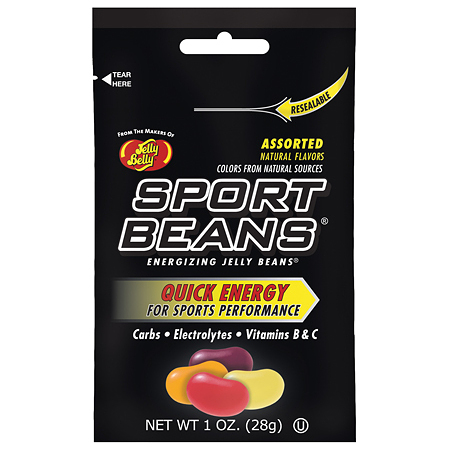
Maybe this should have its own section, but it's close enough that I'll call it a chew. The multiple flavors/pack in the Assorted flavor is nice, since you can mix up the sensations in your mouth. It's small, and it's easier to just suck on them than it is to suck on the larger normal chews. Since jelly beans have a sort of shell, it makes it more suckable, too. It does get sticky between your teeth like the other chews, though. I liken them to very sweet shots.
Drinks
On training runs, I don't like to carry liquids, since it adds to weight and pounding. So I only really use these when I'm a) in races, or b) biking. The normal concentrations are supposedly ideal for ingesting the most carbs (to concentrated, and digestion actually slows down, too diluted, and you don't get as much as you potentially could). However, I find them to be too sweet, so I dilute it... maybe about 2:1 drink:water. It's most comfortable to me this way. During races, I have to wash down my sports drinks with water. I think if your body wants it that way, go ahead and do it, even if studies say that there's some other ideal concentration.
Cytomax:
I like. Maybe just because it seems the most high-tech to me of the standard sugars-only drinks. Probably all in my head. It also comes in powder form, if you want to mix your own concentration. They also have protein versions, but I've never tried them.
Gatorade and Powerade:
I haven't tried these except in races, so I can't say very much about them. They're fine to me, as long as they don't have High Fructose Corn Syrup. There are different kinds, like special endurance formulas and special this and that, but I just take what they give me.
Nathan Catalyst:
It's pretty much sugar-free, so it's mostly for electrolytes. It tastes fine, but it's missing the full kick without sugar. If you're going long enough to need electrolyte replenishment, I'd think you'd need some glycogen replenishment, too. Plus, this thing needs to be prepared ahead of time. You have to put the tablet in a bottle and let it de-fizz for 30 minutes. And they mean it. It'll fizz for 30 minutes, whether it's in a bottle or in your tummy... best if it's in the bottle, if you know what I mean. I made that mistake once. Not comfortable. I've tried it twice, but for me, no thanks.
Proteins
There are different forms of protein. You definitely should take some after hard workouts, but there's also science to suggest that it's good during long workouts (http://www.active.com/running/Articles/Fueling_for_peak_marathon_performance.htm).
Body Fortress Whey Powder:
Whey is great for recovery and for satiation. When I don't have any standard protein that I can bring for lunch at work, I just bring some powder in my shaker, and I'll add water and just have that as my protein. Why whey? http://www.newenglanddairycouncil.org/docs/Whey_Protein/Whey_Protein_and_Satiety.pdf
As you can see, this doc was put forth by the dairy council, but there are enough studies saying the same thing, plus my own experience, so that I'm satisfied.
Sustained Energy by Hammer:
This stuff is meant for workouts of two or more hours. It's made up of complex carbs and some proten, mostly. It has instructions for the standard drink mix, but it also tells you how to make a gel out of it, if you want to carry it without having to carry extra volume (although you'll still need to get that water somehow). It's unflavored, which is a nice change from the sickening sweetness of basically most other products. It's a bit like pancake batter, maybe due to the protein powder. Not so much a gel but a paste. For my first test run with it, I stuck it in a soft flask.
Wednesday, August 4, 2010
GEAR GUIDE: Saucony Fastwitch
I want to be fast, and for every lb trimmed, you speed up by 2s/mi. Unfortunately, over a 5k, that's only 6s. I guess if you have a lot to lose, you can quickly gain time by trimming 5lbs. I wonder whether that rule of thumb holds true for all speeds. Over 26 mi, though, it's a minute. Still not that much if you're talking just 1lb... a minute out of 3:40:00 isn't much, but when you think you're right on the border of a BQ, even a few seconds are precious.
Anyway, as I near the best shape of my life and try to enjoy my prime and not waste an opportunity, I want to see what I can do. Using shoes with less support can be risky for overpronators, at least according to the conventional wisdom that is being challenged nowadays by the minimalist and barefoot movements. So I can run a little faster but at greater risk. XC flats give very little cushioning and make lateral rolling easy (= less support), but I found some sweet lightweight shoes with a medial post, though... the Saucony Fastwitch.

FEATURES:
The Good:
Cool colors - I'm a fan of fluorescent colors. Color should be the least of one's concerns, but can't help it. It looks fast and serious.
Vents along the shoe sole... so don't step in puddles, but for dry road races, you'll enjoy all the benefits of cooling, plus reduced shoe weight.Medial post - for ovrpronators like me.
The Bad:
Much like the Saucony Progrid Guide (it feels very much like it, besides the reduced weight), there's not much heel support, so it's easy to roll inwards/pronate, even when just standing.
MY THOUGHTS ON USING IT:
These guys feel sooo light. I weighed my Asics Gel Evolution 3 with SofSol stability arches as 1.3lbs, whereas the Fastwitch was 0.75lbs. Not even the 6s 5K boost I'm looking for, but they feel fast (and the mental effect is huge in running).
Since lighter shoes have shorter lifespans, I wanted to use these guys sparingly. I originally thought that I could only use them in 5K's, since any longer distance my legs may not be able to handle. And even then, only the 5K's that count the most, where I have the potential to PR. AKA not in the summer, where there's little chance of a PR. Don't waste shoe mileage and injury risk on a summer 5K. Come fall and winter, though, bring it. Watch me fly.
But I decided to break them out today, for a few reasons.
1. You shouldn't try something for the first time in a race. What if I discovered mid-run during a winter 5K where I'm in potential PR shape, that the shoe doesn't fit right? Bad news.
2. It's good to do speedwork in light shoes, since they get you higher leg turnover, which is the goal of speedwork.
3. I needed a reward for working hard... at work.
4. Shoes need breaking in.
5. If I am to run 5K's or potentially 10K's in these, and if in the future I want to move towards more minimalist shoes, my legs (especially the calves, achilles, ankles) need to be strong enough to handle it. Easing into it is the best way to go, to give the body time to adapt and strengthen without breaking.
So after that treadmill speedwork, they still look bright and new, and they seemed to work pretty well. Looking forward to my first race in them! Still don't know if I'll wait for the cold 5K's, or if I'll race in them even in the summer 5K's.
Monday, May 17, 2010
GEAR GUIDE: Mileage Tracker
[PICTURE OF ALL THE CARDS TO BE ADDED LATER]
Saturday, January 9, 2010
GEAR GUIDE: Nathan Shadow Pak

I've only had one test run on this product, but I think that's enough for this kind of product.
Compared to SPIbelt:
The Shadow Pak is very similar to the SPIbelt. I tried to look for reviews of the Shadow Pak vs. the SPIbelt when I was deciding on which one to buy. The SPIbelt is widely used, but I was able to find the SP for a few dollars less. Note, I've never used a SPIbelt, but I did try one on, and it seemed very snug, no-bounce, and comfy. So I was tempted to go with the tried and true product, but the SP had a few things going for it.
Besides the discount I found, it has reflective accents (I've been really into reflective and highly visible gear lately, since I now am often forced to run at sunset on workdays if the season's right, and/or in areas with much heavier and faster car traffic than in my personal running utopia of Pton.
Anyway, the other plus is a built-in ID tag. I've never really cared about ID'ing myself. I figured that if I was found maimed but alive, I'd get medical help regardless, and if I was found dead, they'd figure it out eventually that it was me. Since I don't stray that far from home, that could fly. If I wanted to run in another state while on a trip, or if I wanted to go to a remote area like trails in the mts, I would definitely see it as a good idea, though (actually doing it is still another issue). So I consider it too bothersome to buy an ID bracelet or to stash my Driver's License, but since it's already in the SP, great. Kill yet another bird with a stone.
The SP has a mesh bag vs. the SPIbelt's like... thick spandexy bag. I think either of the two would be fine. I guess your items may get sweatier with mesh, but you also get to breathe better. So that's about even. One benefit of the SP vs. the SPIbelt, however, is that the zipper is at the top of the SP, so things don't spill out. As I said, I've never tried the SPIbelt, but since its zipper is in the front in the middle, you may have to be a bit more careful about not spilling when trying to access stuff while moving at 7mph. The third point of comparison about the bags is that mesh doesn't expand that much, but spandex does. With the design, though, the two take up about the same amount of space anyways when not full. You could probably force a bit more into the SPIbelt, though.
Test Run with the SP:
I had been concerned that the SP was a knock-off of the SPIbelt that may look visually superior but be functionally inferior. I was most concerned about the bounce. I can happily report that there was no bothersome bounce, though. There is a lot of extra strapping, since my waist is smaller than average, and I had to tuck them into itself, which does make the belt not smooth against my skin. No chafing issues for this distance. 8.6 miles is short, so I never accessed stuff stored inside (this time, I had Shot Bloks and keys). So I guess that's all I can really say for now.
Largely makes my Race Number Belt obselete, since the pouch is more secure than the straps for holding Gu's, and safety pins can easily be used to secure the number to the SP. I guess the Belt can be slightly advantageous in short races that require nothing (due to the lighter weight), like small 5K's where you are totally safe putting your keys in your gear bag out in the open.
// Added 8/14/2011
This is the most popular post in this blog, so I think it's worth giving an update. It's been over a year and a half since I first purchased this product, and I'm still loving it. Still no chafing.
If you're wondering about volume, it's big enough to squeeze in my iPodTouch, but if you put that in, that's about all it will be able to hold. If you were to look at a 3D model of it, it really has a rectangular-ish base (ends are pinched), and the top is the zipper, and the sides would be triangles (but pinched... so a triangle in the middle, but towards the end, they become lines).
I don't think I've written down contact info yet, because I'm afraid that if I move, it'll be outdated.
I've seen that they now sell it in many different colors. Black is nice because it matches everything and is less obtrusive for the rare occasion that I wear it out... not while running, but reflective or fluorescent would've been my kind of thing, too.
// Added 9/18/2012
Still going strong, 2.5+ years later, with about 1-2 uses per week, by a fairly speedy (read: sweaty) runner! I even bought a second one recently, in case anything ever happens to my current one.
Here's a picture of what it looks like, full:
FYI, I'm shirtless 99% of the time, even in the dead of winter (I live in the South), and still, no chafing!
Monday, December 14, 2009
GEAR GUIDE: Foam Roller

Got it 4 days ago and have been using it every day since. I don't know whether it gets less painful b/c you're becoming more flexible, or if you're just getting used to the feeling.
This thing is versatile - you can work your 1) shins, 2) quads, 3) calves, 4) hamstrings, 5) upper butt, 6) inside thigh, 7) IT band, 8) upper front thigh, 9) back. You can add pressure by putting one leg over the other to double the weight. You can point your toes different ways to hit different sides of the muscles.
You also get a nice arm workout, and I often end my working of a spot by collapsing and just lying there for a sec.
$20 seems pricey for a piece of styrofoam, but that's less than the cost of a single massage session, and you can do it whenever. This brand also includes a well-made DVD, although you can find plenty of similar videos online, I'm sure.
Saturday, September 26, 2009
GEAR GUIDE: Visor

You can recognize me from a mile away by my visor. It's a wonderful all-purpose accessory. Mine's made of cotton and isn't one of those new tech-fabric types, but it's still comfy, and even after many, many washes, it still fits pretty well.
I wear it...
IN THE SUN - I fear destroying my eyes. Frisbee (and most other sports) are really bad for that, since you have to look up to catch balls/discs. Even when just looking straight ahead, it's good to not have the sun blinding part of your vision. Even though the visor technically blocks out part of my vision, you can see at least the lower part so much better without the sun's rays overwhelming most of your view. Not to mention all the benefits of preventing sunburn.
IN THE RAIN - It's even more of a must in the rain than in the sun. When you're running or playing, you don't have rain dripping into your eyes, making you wish you had windshield wipers on your face. It blocks out all of that so that you can just focus on running without having to rub your face dry all the time. It was critical in frisbee games, and it adds a lot of comfort to runs.
IN THE COLD - It keeps your head warmer while blocking the sun.
INDOORS - I even wear it indoors all the time. People must think I'm crazy. I like how it keeps my hair out of my face, though. I like it. Deal with it.
Monday, May 4, 2009
GEAR GUIDE: Daniels' Running Formula

Haven't finished it yet, but at least the first half is AMAZING. It has lots of practical advice on how to design a training program, which is what I need to keep myself from driving myself to injury. It may also help me get faster, since it's now May, and I've been declining in speed since March! Don't know why. Maybe temps?
A major concept in the book is the VDOT, which is a training level that can be predicted based on times. You're supposed to train at the highest VDOT any of your best performance in any of the distances suggests. In my case, my 6-minute mile and my 21-ish 5K suggest that I'm at a VDOT of 49. According to Daniels, this means that if I train particularly for the following distances, I can get the following times: 10K - 42:50 (sounds about right, perhaps a tad bit optimistic for my level now), a 1:33 half marathon (I think the best I could do now is 1:48), and a 3:14 marathon (uhhh... no). Now, marathon fitness does take years to build up to, but 3:14... really? The BQ for women age 18-35 is 3:40, and for men, it's 3:10. Seriously? To simply BQ (haha - simply), I'd have to keep up my current estimated best half pace of 8:18-ish for another 13 miles!!! My heart grows faint at the thought of it.
PACES
Based on my VDOT, Daniels suggests paces for different levels of workout difficulties. Easy = 8:40/mi, Marathon = 7:24/mi (that's faster than how I ran my 7.t today), Tempo = 6:55/mi or 4:20/Km or 1:43/400, Interval = 3:59/Km or 1:35/400, and Repetition = 1:29/400 (right where I did many quarters during the 20x400 workout) or 0:44/200.
The purpose of Easy runs is to give you a pace for the additional run on 2-workout days, recovery runs (30-60 min), warmups/cooldowns (10-30 min), long runs (up to 25% of the week's total mileage...I totally break that rule with my 16's in 20-mile weeks... probably much to my detriment), and base training and maintenance. 75% MHR
The purpose of a Marathon pace run is to have an intermediate level that's faster than easy but slower than tempo. It can be used for some longer runs, and you can practice marathon fueling or whatever else during it. If you're feeling good on a day designated for Easy, you can jack it up to M pace. Run at this pace up to the lesser of 90 min and 16 miles). 85% MHR
The purpose of Tempo training is to work your lactate threshold. Daniels says that the ideal duration of a tempo run is 20 minutes, but that you should be able to maintain that pace for an hour in a race, so the range is 20-60 minutes. The 6:55/mi tempo is right about my race pace for a 5K. I don't know how I could hold that for another hour, so that's kind of weird. Tempo's can be split into two kinds: regular, and Cruise Intervals, where you go at tempo pace, but you get to take breaks up at minimum of every 15 minutes, with breaks lasting for 1/5 of the time you ran. This lets you go longer than the usual duration/mileage during the workout, since you're allowing some time for lactate levels to go down. (This is what I actually did on the day I did 7.5 with my 5-ish breaks necessitated by the heat.) Have the total of this type be the lesser of 10% of the week's mileage and 60 minutes. I call my wf and wm runs tempo runs, but they are definitely not tempo pace. They're btwn marathon and tempo pace. Make it comfortably hard but about 30s slower than 5K race pace. 90% MHR
The purpose of Interval training is to boost VO2max, and the pace should be sustained for 3-5 minutes, because it takes 2 minutes for V02max to be reached. If you do do less than 3, you have to cut your rest time down to be less than or equal to the running time spent (I was probably at about equal rest time during the 20x400, making it about borderline I and R training, mixing the running economy benefits of R and the VO2 benefits of I. It did require a good bit of rest afterwards, though, and my legs had been numb for the last few 400's). Make the total I training per week equal to the lesser of 10K and 8% of the week's total mileage. Go hard but not all-out. 99% MHR
The purpose of Repetition training is to boost running economy and strength, which is all about form, and tuning up your anaerobic system. Each rep is up to 2 minutes long. Rest times are allowed to be as much as you need so that you can run the next rep as fast as you did the previous one. Sounds good to me! The total R should be the lesser of 5 miles and 5% of the week's total mileage. Go hard and all-out but in control.
TRAINING PHASES
Ideally, this is a 24-week program, with four phases lasting 6 weeks each:
I: Foundation and Injury Prevention - getting cellular benefits, don't increase stress too rapidly, get into habit, easy runs and strides - EL (easy, long runs)
II: Early Quality - preparing for TQ and FQ, intro faster workouts, especially reps to improve economy and strength, also start some thresholds - RITE (reps, ints, tempo, easy)
III: Transition Quality - the most stressful, event-specific, optimize all your systems, good rest and injury prevention critical, lots of interval and threshold running - TIE (tempo, ints, easy)
IV: Final Quality - prepare for actual race conditions like heat acclimitization, threshhold - TIME (tempo, ints, mix?, easy)
Saturday, April 25, 2009
April 25
I do appreciate getting to play more than I did at sectionals. I do love the fact that I could run enough to get tired and sore out in the 88 degree heat. What is unique about today is the food I ate, though.
FUEL:
Breakfast: Lentil and Pureed Veggie Soup; Yogurt w/ Wild Berry Fruit Spread and Granola; Hummus
Snack: 1 Pickle (salt was soooo good after sweating so much. I love the very unblandness of it, too, and that it's a bit refreshing liquid-wise. I usually don't eat pickles because I think it might turn you into a mummy or something drying you out and preserving your insides with all the salt and vinegar... delicious.)
Snack: 1/2 Orange; 3/4 Protein Bread w/ Hummus Sandwich
Snack: 2 Pickles... I was craving moer the whole game; 1/4 Protein Bread w/ Hummus Sandwich
Snack: 1/2 Orange; BBQ Chips... more delicious salt and unbland crunchiness
Snack: Apple; Assorted Gourmet Cheeses (only at Princeton do I eat Brie and other unknown aromatic cheeses on the sideline of a tournament. and only at Princeton do you ride to tournaments in your friend's Porche... those are two things that I thoroughly enjoyed about frisbee. there were other enjoyable things, for sure, but man, that was sweet).
Snack: Pickle
Mini-meal: Starbucks sample coffee w/ Skim Milk and Sugar in the Raw; Lentil and Pureed Veggie Soup
Summary: many pickles, full-fat savory cheese, fruit, soup, dairy, and hummus sandwiches.
Oh yeah, ended up not doing the 5K.
Injury Report: I think I have minor case of Posterior tibial tendonitis. I've had it since about the epic 20 quarters workout. It was bothering me this morning, but I don't feel it now. Also, I did a number on my knees doing the worm last night on concrete for the arch sing. It didn't help having to lay out or catch peoples' too-low throws today. I felt very unsteady in the latter part of the tournament, when the muscles that usually provide control were getting more fatigued and the joints just seemed to be barely holding everything together.
GEAR: At Communiversity, I got $40 Saucony ProGrid Guide XT-900 shoes. Regular price is $95, although RR sports has it for $60+ship. They're a lighter weight (although still 9.6 oz) mild stability shoe. It has breathable mesh. Now that I have 2 Gel Evol3's plus a Brooks Trance 8, this will be my fourth new running shoe. Excessive? Yes. But all the good deals unfortunately came at once. The deals got progressively better, so I felt like I had to keep going. And the new ones were brands or models I've never tried before, so I couldn't pass it up. Well, I'll be set for a while. And considering I'll probably go through 2 pairs a year, this seems okay.
Something I learned recently: One reason that it's good to have two pairs of shoes going at a time: by alternating, you'll give the shoes time to re-puff their cushioning. I didn't know it was that dramatic, but it does seem possible. From personal experience, it may also be a good idea to have sport-specific shoes. I guess I take it more to an extreme with workout-specific shoes. I want something lower to the ground for plyos, where there's a risk of turning an ankle if I'm too top-heavy, making something like the Brooks Trance Good. I want something lightweight for the track, which would mean the 9.4 oz Progrid is better than the 11 oz Gel Evols. Lighter means less durability and less support, though, making the Evols better for when I do my bulk mileage, like my long and tempo runs. I may have one I wear to walk around in, which I guess cheaper, less supportive and more flexible shoes would be good for.
Within the past week, I've paid $70 for Gel Evol 3's (I won my first pair, which were 2's, at a race; I bought 4's for $90 - retails at $120), $37 for Trance 8's (I bought my first pair, 7's whose cushioning/stability support didn't last that long, for $100), and then I got these Progrid's for $40 today. I guess $40's not bad, considering it's $150 for three shoes when sometimes one shoe costs about that much. I do have a lot of shoes now. It's kind of funny. Most girls collect endless amounts of pretty sandals and heels and stuff. I have one pair of nice close-toed heeled shoes I wear to work (and they hurt after a while). I have a pair of Old Navy shower sandals that I wear on a regular basis out in public, as well as an extravagant $10 (although regular price is more) suede Adidas rainbows-like pair of sandals. And then, I have my six pairs of running shoes. How will I explain all the shoes to my parents? The Evol4's look okay but need to be retired from regular running use. The Trance7's I use to walk in when I'm forced to wear something other than sandals (which means it's raining - otherwise, like at Church and class and everything else, I wear sandals). I also use the 7's when I go to the gym, since I don't want to mess up the wear patterns from running that I've established in the Evol's. And now there are three brand new shoes. Woo hoo.
Speaking of spending, I've also bought a $25 tech shirt (which unfortunately I think now may be available for something more like $10 on Ebay), and five running books (Once a Runner - $16ish, A 3-book Sheehan compilation - $5ish, Running with the Buffaloes - $7ish, Lore of Running - $20, and Daniels' Running Formula - $13ish) that total up to about $60 oh my... I'll need something to entertain me when I leave Pton and have all that free time, though. And I've spent much more than that in terms of opportunity costs (from missing work shifts) due to frisbee. It's time running gets something.
Monday, March 30, 2009
GEAR GUIDE: Running Logs
I think I've extolled the benefits of keeping logs elsewhere in this blog, but not in a formal Gear Guide setting. So I'll talk a little bit about overall benefits of keeping a log, and then I'll describe how I've organized my own Runner's World Log.
Things you can track:
Workout Type
Running Course
Temps & Clothing
Time of Day
Workout Time & Splits
Pre-run and During-run Fuel
Injuries
Sleep / Mood
Weight, HR
Tracking these will help you:
1) Monitor progress - you can see how your times for a particular course drop
2) Look for patterns - what kind of training level makes you more injury prone? Are you in danger of increasing training by too much too quickly?
3) Explain trends - maybe it's because of increasing temps, and not lack of effort, that you're going slower.
4) Discover what works - maybe you're a tee shirt as long as it's above freezing type of person. maybe you shouldn't eat chocolate right before a run. maybe long runs are better in the morning than in the afternoon.
Column 1: Day/Date. This is a 52 week journal.
Column 2: Distance, in miles. If I do body weight strength, I put an "S" instead of a number of miles. If I do cross training, I put an "X". If it's an ultimate frisbee practice, I put a "U". If it was a rest day, I put a black rectangle.
Column 3: Time. If it's a run, I do the time. If it's strength, I put the time in parenthesis. If it's Ulty, I don't put the time, since only a certain percentage of the time would be running. If it's a random sport that is stop-and-go, I don't put the time. If it's an endurance sport, like a cardio machine or swimming, I'll put the time in parenthesis.
Column 4: Course. I write the course and the splits.
Column 5: Comments. Here, I'll write the temps, my clothing, the injury report, where and how much I felt like stopping (haha, kind of funny that it deserves a spot in my list of common forms of comments. Usually just applies to track workouts, though.), sleep, time of day, weather, fuel, pretty much the stuff on the above list, as long as it's remarkable.
Bottom: Mileage Totals. You sum your weekly total. Then, you add it to your year to date total. That results in a new year to date total.
Extra: I also track which running podcast episodes I've listened to.
Sunday, February 15, 2009
GEAR GUIDE: Fuel Belt (Nathan Speed 4)
Product Specs:
- Molded holsters for quick Flask access
- Four 10 oz. Nutrition Flasks
- Front and rear stash pockets for small essentials
- Airmesh moisture-wicking backing
- Limited-stretch elasticized waistbelt with soft perimeter binding
- Weight distributed evenly around belt
- Three sizes: SM 26-32", MED 32-36" & LG 36-42"
Last time on the 14.5ish mile run, I was thirsty on the way back and had to stop at Target, even though it was below freezing. I usually also get hungry at around mile 10, depending on how much I fueled up prior to the run. I knew that I'd need an easy way to stash water and food for these runs, and hopefully longer runs in the future as I train for the marathon. The backpack may do the trick, but it slows me down and doesn't promote the best form, since I tend to twist at the waist less (resulting in strain on my knees, I think, somehow) when I wear it and forget to maintain good form.
Road Test:
For the 14mi run on 5/15, I brought 16oz of water for this "feels like 36/37 degree (acutal probably 42ish)", and had about 2oz left at the end, so it worked well. I have a capacity for 40oz of water to be used in far higher temps and hopefully longer distances, although that would add 2.5 pounds, not to mention any food or gear I'd want to bring.
I filled each of the two front flasks w/ 8oz of water, had a baby pack of gummy bears in the small front pocket, had a camera in the larger back pocket, had a PB&Honey WW Flatbread Sandwich in one of the back flask holsters, and my prox/credit card and my Survivor Buff in the other. I ended up not needing the sandwich or the bandana, and I would've eaten the gummy bears (which I've heard one guy using as a cheap substitute for Clif Shot Bloks), but they were rock-hard due to the cold.
Conclusion:
It's nice to have all of that carrying capacity in a no-bounce, good-fitting way. Chafing wasn't even an issue when my shirt would move out of place. It turned out to be pretty flexible in what kinds of things you could stash. I kind of felt like a car, with gas tanks (water) on one part of me, and the trunk (empty holsters) in the back.
Sunday, January 18, 2009
GEAR GUIDE: Buff

Here's a versatile tool to keep you warm in the winter. I got the Survivor Buff in HS from my good friends who knew me very well. I've used a couple of times this winter as it's gotten colder. The coolest thing about it is the number of ways this seemless tube of cloth can be used.
Yesterday during the 19 degree run, I did the scarf so that I could trap in some of the warmth I breathed out so that I wasn't sucking in so much cold air. About a week ago, I used it as a headband for general warmth.

DETAILS (from website):
- An amazing stitch-free, seamless accessory
- Thermal, offering protection from the wind, sun and humidity in both cold and hot weather
- Highly breathable, absorbs sweat, dries fast and provides UV protection
- The perfect travel accessory for all environments
- Comfortable and versatile: 12+ ways to wear!
- Colourfast and machine washable
- One size fits most adults
- Polygiene® to ensure total protection from bacteria, and lasting freshness and comfort
Friday, January 2, 2009
GEAR GUIDE: Cell phone/ Music Player

I got an LG Decoy phone recently. Now, when I carry it, it serves not only as a phone in case my parents want to ask where I am, or if I get stuck somewhere on a run and need a ride, but I can also listen to music. Like the iPhone, it'll play songs aloud with its built in speakers. The sound quality is good, particularly indoors. Outdoors, the highest volume level isn't enough anymore because of the sounds of cars, nature, and kids. I often have to hold it up closer to my ear, making less than efficient running form. Since my Shuffle is at school, though, it's good enough. It comes with a built-in bluetooth, which is an awesome feature, but I've been too risk-averse to try running with it in my ear, since it may fall out and get crushed or something.
What I'd really recommend is that anybody working out put podcasts to listen to on whatever music playing device they have. The ones about training or nutrition are informative and motivating, and they are really good at keeping your mind off the pain or the mileage. Time flies by when you're concentrating on something else. I put a variety of podcasts on the Decoy recently. I just googled sports nutrion or running podcasts. Good ones are therunningshoe.net and steverunner.com. There are even ones where the hosts are actually running during the show, so it feels like you're running with someone. It was kind of funny. A good idea, though, that may lead to something even better. You could put running training programs on podcasts. You could do fartleks with it or something that's not straight-up distance but time.
Saturday, December 8, 2007
GEAR GUIDE: Acumen HRM

Heart Rate - Displays ECG-accurate current heart rate when transmitter belt is worn. Set your Target Heart Rate Zone or determine your zone automatically with the EZ-Set Target Zone feature.
EZ-Set Target Zone - Determines personal heart rate limits for an exercise session. The EZ-Set Target Zone feature can determine an individual light to moderate intensity exercise zone (65-85% of the maximum heart rate). The Acumen Heart Rate Monitor will automatically calculate lower and upper heart rate limits limits based on your age-predicted maximum heart rate (220 minus age). You can also program your own Target Heart Rate Zone with user defined values.
In-Zone Goal Countdown Timer - Set 0 - 60 minute timer to begin when Target Heart Rate Zone is reached.
Calories - This feature in Acumen Heart Rate Monitors estimates the number of kilocalories expended during exercise based on heart rate and inputted exercise intensity index. An Exercise Factor table is provided to assist individuals in choosing an exercise intensity index. Displays estimated calories burned when receiving heart rate signals.
Saturday, November 10, 2007
GEAR GUIDE: Fleece Jacket

Perfect for climate-controlled performance, the Burton Indy 500 Fleece has many features designed to keep your body at a steady and comfortable temperature.
- The collar part comes up to keep your neck warm. The neck and head are the biggest heat-losers (that's why if you're overheated in the summer, the best thing to do is put a wet towel around your neck - it's b/c much of your blood's passing through that small area, so you can access it easily), so this is really helpful. It's also a nice guard against chafing by my black bookbag, which I wear while I run. It's often packed full of stuff that I'll have to carry for 3.25ish miles, bounding around, making me have two lines rubbed raw on either side of my neck by the time I get home. That's a problem in the summer, so I have to hold down the straps at the bottom of my bookbag while I run. In the winter, though, I'm protected by Burton Fleece.
- The cuffs have zippers, which is great for mannual temperature regulation. It helps a lot to vent out excess heat when I'm running in cold weather. The regular front zipper's great for that also.
- The fleece itself is warm. It's thick but doesn't leave you too hot - just nice no matter how cold it is.
Sunday, October 28, 2007
GEAR GUIDE: Ironman Flix Lap Watch
FEATURES:Green Color INDIGLO® night-light
FLIX System: hands free INDIGLO night-light > useful for bike rides at night, racing to precepts on time
All-day-white reflector display
30-lap memory recall > will be good for track
Top pusher for easy lap/split > good for track
99-lap counter
Forward/backward setting > speedy setting
Built-in setting reminders
Customizable mode set: > can keep out features you won't use
Occasion mode: 15 preset occasions
3 alarms: daily/weekday/weekend/weekly
3 time zones > a little excessive - who uses these? really!... well, maybe world-class athletes who travel abroad for competitions
24-hour countdown timer with countdown/stop and countdown/repeat > good for abs workout timing
100-hour chronograph with lap or split option either in large digits > intervals
6 year battery life**
Water-resistant 100m
Thursday, October 11, 2007
GEAR GUIDE: Polarized Sunglasses
Polarized is the way to go. 
(from http://www.technical-gear.com/sunglasses/polarized_sunglasses.htm)
It's great for running, walking, everything. You don't even need to take it off - everything kind of stays the same brightness whether there's lots of sun, or whether it's all shade. The lenses are very clear and crisp, not dizzying and blurry like another pair of glasses, same brand, I had (I use Ocean Pacific).
Sunday, September 9, 2007
GEAR GUIDE: Homemade Agility Kit
__________________________________________________________
WHAT: Cones for accel/deccel, quick turns, agility.
QUAL: Haven't stepped on one yet, but it should fold back into decent shape if I do step on one.
PRICE: Normally $1/cone
____________________________________________________________
WHAT: 9-rung agility ladder, made of hemp & rubber rings
QUAL: functional, though resetting takes longer than it does on a real ladder - more incentive to not mess up, I say
PRICE: $40, though theirs are more convenient storage-wise and resetting-wise
WHAT: Agility Hurdle, good for skier lateral jumps, and front/back jumps
QUAL: Let's just say "many reasons to not mess up"
PRICE: $10 per hurdle, but the real ones are way, way better in this case
Monday, August 27, 2007
GEAR GUIDE: Nalgene

At home, I use a knock-off 1L blue-green, Rocky College Nalgene. It's a good thing it's big, since I've been drinking 2 gallons/day this summer. I fill it up so often and down it quickly. I carry it with me in my purse when I go out, and I bring it to church, even.
At school, I use a knock-off 1L orange Rocky Nalgene. It's tougher to bring around at school, since I don't drink as much there, and my orange Camelbak's kind of small. I just use that one in my room. I love water fountains near my room. 101 last year was really sweet, with nice access to the water fountain and the bathroom (the two go hand in hand). To carry around campus, I've kind of long-term borrowed (commandeered) a friend's mini-0.5L Nalgene, though, and that fits in the front mesh pocket pretty nicely. Water in Pton tastes nasty, but it's water. Hopefully, I'm not getting high concentrations of mystery toxins by drinking as much as I do.
I went biking to the gym once and dropped my blue-green Nalgene while it was full. It made a huge noise, since it was heavy. It got couple short but sorta-deep scratches, but other than that, it's doing great. Also, I once got mad while talking to my dad and started ripping at the plastic lid attachment chord of the Nalgene. The loop around the lid just got stretched to the point that it popped off, but I was able to pop it back on and has had no trouble staying on. It's very durable, I was glad to see.
Haha, nobody probably cares about the details of my Nalgenes. Oh, but I like them, and it's kind of late, so I'm just telling Nalgene stories.
Oh, it gets cloudy on the inside without you realizing it, so wash it every now and then, even if you're just refilling with water. You'll get around to washing it, and it'll look so different when it's clear that you hardly recognize it. True story.