Pages

Sunday, December 11, 2022

GunRun Team Match @ Sawmill + GORUCK Bragg T/B 2022

TRAINING LEAD-UP

Sunday, Jan 9:

HDT SIAS 15 min AMRAP with a 40#SB, covering 4 rounds and 27 reps, followed by the Green Beret Fitness Operation Endure Hansen+ WOD in 32 min with a 30# ruck.  I wanted /needed upper body work today.  

Did 3 miles afterwards with 30# in the Speed Rucker, wearing Ballistic Trainers, for active recovery and blood flow.


Monday, Jan 10:

Adventure Race Brick: (inspired by SB, who got the idea from her past triathlon training)

  • Biked 5.75 miles on the road and on the wooded trail for 38 min
  • Ran.1 mile in 8:24
  • Biked 4.5 miles in 34 min, with a bike mounted light because it was dark by then
  • Ran 1 mile in 7:47
No chamois, no issue.  Did take a bathroom break after each bike session.


Gear prep for the Sea to Sea Adventure Race:


Thursday, Jan 13:

Mobility | MOVE - 30 day yoga journey with Adriene for 23 min.

Friday, Jan 14:

PATHFINDER Compete PT Test #4: 48 pushups, 81 situps, 13 squat cleans @60#, 14 push press @60#SB/30#R, 110s dead hang with 30#R.


GUN RUN TEAM MATCH @ SAWMILL

This year was the first year they offered an HTB version of Bragg, the king of all rucks.  The HTB finisher patch looked really cool, but I had to make the tough but necessary decision to only do the T/B, so that I wasn't still smoked by the time the 72 hour Sea to Sea adventure race rolled around.  I needed to be at my best for that, for the team.

It's still cool to get to do the T/B, though, and I know that I'd be a welcome sight for the HTBers who would need fresh reinforcements by the time the Tough rolled around. 

Another benefit of only doing the T/B was that I could squeeze in a GunRun Team match on Saturday morning.  My usual battle buddy SB couldn't make it, but that meant that I could try the event with a different partner who I also enjoy hanging out with and all around fantastic guy - Pete.  This would be his first time doing a G&R event, so I was excited to introduce another tactical athlete like him to this event format.  G&Rs are so much fun, especially the team variation.  We had a 9:50am run time, which would allow me to run and then head out from SC to Bragg afterwards.  


The minimum round count was 40 rile, 35 pistol, but I brought 7 mags of pistol and 4 of rifle, to be safe.  I finished with 10 pistol, 45 rifle left over.


We began with a litter carry with a log, over to the obstacle course, where we did a cargo net, wall, and pommel logs (sternum checker), and then we carried the litter back to the start line.


Stage 1:

The first stage was the connex, which we failed, but 65% of the teams failed this, too.  The PAR time was 180s... it's typically longer for team matches, than it is for individual matches, where the cap is usually 90s.


Shooter 1 goes to the third floor to hit a silhouette target at 130yd with 3 shots from each of 3 shapes on the VTAC board, onto a 2/3 IPSIC torso.  Bottom right = big triangle.  Top left = diagonal shot, where I struggled to see the target because the port was so high, but the RO pointed out that there was a pallet nearby that I could pull over and stand on, but I wasted about 40s in the meantime.  The middle port was a big square.


While I was doing all of that, Pete had started with pistol on the ground level, hitting 2 shots on the body and 1 to the head, on 2 targets, before he grabbed an ammo can to run up the stairs to where I was still working.  He had to wait there on the side until I finished.


Once I finally finished my rifle shots, he could come over, and then I had to communicate to him what ports to use and which target to hit, but I wasn't allowed to name any shapes, or point, so you have to get creative with your wording.  I made a mistake and forgot that where the target was wouldn't be obvious to him, so it took a while for me to explain it to him and for him to find it, so we lost another 30s doing that.


Stage 2:

We ran to the riverside, for another 180s stage, which we did pass, along with 81% of the field.  

Shooter 1 engages 4 targets with 3 hits each, at about 150yds, I'd guess.  Once they start shooting, shooter 2 can move into position farther down the horizontal line, and start engaging the same targets once the first shooter finishes.  I was able to take what I learned about seeing the target and squaring up from precision rifle.  


Next, the RO would pick one of us to be the casualty, and the other would apply a TQ and then drag the casualty about 15yd on a skedco.  I could pull him OK, with Pete being allowed to use his feet to help.  It would've been easier if I had been the casualty, so I'm guessing the ROs were told to pick the bigger/stronger one to be the casualty.


After that, I shot 2 circle targets with pistol, with 2 rounds each.


Stage 3:

The next stage was at the long range bay, with a 90s par time.  We failed, along with 68% of the field.

Shooter 1 hits the closest target (175yd) with 3 shots, standing.  Shooter 2 does the same.

Shooter 1 hits the next farthest target (215yd) with 3 kneeling or sitting.  Shooter 2 does the same.  I timed out during this.  I was very unstable in my posiiton.  

If we had made it, we would've continued with the pattern to prone at a 340 yd target.  We weren't told what the ranges were until after the event during the Instagram AAR.  

I had an LPVO on my rifle, but Pete just had a red dot.  We were allowed to share a rifle, so Pete tried it, but he couldn't get proper eye relief and went back to his red dot.


Stage 4:

In the forest bay, I held a punching bag while Pete did 3 strong hand, 3 support hand, at a 35-40yd target with pistol.  Then, we switched.


We ran halfway down the lane and faced left down a perpendicular lane.  Pete was still carrying the dummy, so I started on pistol.  The target was about 50yd away.  I struggled to hit it with my support hand.  Pete never got a chance to shoot at that one.  I was supposedly missing right and high, and I tried to aim off, but not enough, I'm guessing.  I spent so many rounds on this one.


Stage 5:

At the school bus bay, both of us started simultaneously, shooting towards close paper targets that we shot with rifle for 4 rounds.  I did forget about sight over bore, but the targets were big enough that it didn't matter.


Next, we got behind a car, where Pete made 3 hits each on silhouette targets that were bigger (since he had a red dot), and I went for 8-in circle targets.  From my spot, I had to tiptoe to see over the roof enough.


We put the rifles down and moved down the berm to the bus.  Shooter 1 held the dummy while shooting at the big square steel in the back of the school bus, while shooter 2 shot at 2 circle targets.  


We ran back to the start and finished.  It feels good to finish a stage.

I noticed after the stage that I had lost a full mag somewhere because my mag holster had lost a screw and flipped upside-down :(


Stage 6:

This was my first time using the bay with the small connex structure.  We passed within the 90s par time, along with 75% of the field.

Pete started downstairs, opening the barn door and hitting 3 each at 8-in circle targets.  

While he worked on that, I went upstairs and shot 3 each at 3 silhouettes.  

When Pete finished downstairs, he came upstairs, to repeat what I had done.


BRAGG TOUGH

The Heavy had taken place away from the Special Forces Association campus, since they had gone to the museum and to parks, but the Tough was back at the SFA, the old stomping grounds with which I became intimately familiar during the Bragg HH the previous year.  

Since it was the first time back at the SFA for the year, the event started with a recon ruck around the gas line and powerline trail.


After that warmup, we got a welcome party which was SUPER FUN.  I loved it.  We split up into groups, and were assigned to different cadre stations.  Cadre DS led us in a workout where we had to accumulate 6 min of dead hang, with a little run and a set of pushups each time we had to take a break.  I ended up going for 4:30 for the first go around, and then finished it up in the second go-around.  After that, I got a nice long break.  The monkey bar pipes had small diameters, which made it easier than usual to hang, I think.


Next, we went to Cadre Steve, who had us stand on a picnic table bench and jump into gravel in ways that mimicked parachute training, looking left, right, back left, back right, and rolling safely.  The gravel was perfect for this.  It was fun to roll, and we did little laps each time.

We did 1 loop around the gas line/powerline trail, and I swapped a 60#SB with Megan while I peppered her with questions about her experience last year with Sea to Sea.  It was really helpful to hear about what gear she used, and what the event would be like.  It was a very productive mile!


Next, we picked up logs, moved it over to the Lest We Forget sign, and used straps to do a log low carry around the campus mini-loop.


We did log PT with picnic tables, messed up a bunch, didn't meet standards, and got a bunch of punishment PT for it.

For a Kims game-style challenge, we had to memorize a song from Encanto, called "We don't talk about Bruno".  It was just after the movie had come out, so the vast majority of us had never heard of it before.  Our Team Leader, Megan, fortunately had watched it.  To help us remember the song more easily, she set the stage for us by explaining the plot of the movie.  If you've seen the movie, you can just imagine how crazy the plot must've sounded to us.  I didn't even know that it was an animated movie and Disney movie at the time.  

We decided to have our 4 squads each take a verse in the first part of the song, and just focus on that verse.  Within our squad, we decided to each take a line.  Having done events with Chuy before, I knew that we'd have to really get into it, so we also planned gestures and stuff.  We were huddled in a hut while doing this, which was nice for getting out of the elements, because there was cold rain the whole time.  The rain was actually ice during the second half of the event.


We rucked another loop while practicing the songs.  The whole class learned the chorus part.  Another thing - if you have heard the song before, you know how syncopated the rhythms are. Its's a very challenging one to learn, but cool to listen to.  Some struggle getting the timing of different word intonations right.  

We did another lap with the log low-carried with straps:


We performed the song at the end, and we had a quick patching ceremony, to keep us on track with the timing between events.


In all, we covered 11 miles in about 12 hours.

My ruck was iced over by the end, as was my car!  The door made a big cracking sound as I opened it, because of the sheet of ice breaking up.


BETWEEN EVENTS

Fortunately, I had a friend who let me refit at his place between events.  A warm shower and dry clothes are always such a blessing after a cold and wet event.


BRAGG BASIC

The event started with Chuy in SFAS mode, wearing his green beret, and we began with the APFT.  I did 48 pushups, 78 situps, and a 13:32 2 miler.  I hadn't done the Heavy + Tough like some of the others, so it wasn't as hard for me.

We did picnic table "log" PT, with lots of punishment PT in the middle of puddles.  After you do a number of these events, you learn that failure is nearly guaranteed, because dealing with the failure is part of what you're being tested on.  How do you respond to being told that you're not doing it correctly or fast enough, over and over again, and having to get punished repeatedly for it?  It rained for the first half of the event.


After a bit of railroad tie PT, we did movements with railroad ties.


We rucked to the power line, and we performed the star spangled banner.  I was the TL for a time, and led the class in a modified wedge patrol (which is like a ranger file, it seemed to me).  We sang again when we finished our patrol.


At the end, we did the Chicken Little WOD, a 24 min AMRAP, led by Joe Baker.  Even the Cadres joined in for it, since it was a memorial WOD for one of our own.  The pushups were the most challenging part of it for me, so I rested in downward dog when I needed to.


I didn't eat during the event, because there was no time for it, especially as the TL.  I also barely drank, only right after the run.

We covered about 4 miles in the 4 hours.

I think we had a BBQ after-party afterwards.  The HTBers celebrated their bolts.  I was happy to have another good set of events under my belt, and some new patches.


I carefully drove home through the abnormal conditions, to a snowy home:


Friday, December 2, 2022

Kings Mountain State Park Orienteering Meet - Jan 2022

FIRST ORIENTEERING MEET

In preparation for my first Adventure Race, I worked on developing my navigation skills through orienteering.  I'm fortunate to have a number of permanent orienteering courses in my area.  This would be my first meet, though.  At a meet, there's a self-initiated staggered start for those who sign up, so that people aren't just conga line following each other from CP to CP.  There are different course options to choose from, based on the level of difficulty that you want to tackle from a navigational perspective and physical perspective.  There's a time limit for completing your route by finding all the CPs, and getting back to the start, so choose your course wisely when you sign up.  SB, my co-navigator for Sea to Sea, had another event that she had committed to doing this morning, so I was going to tackle this on my own.

At the events put on by the Carolina Orienteering Klubb, you have 3 hours to complete your course.  The faster you complete it, the higher your placement, within your course category.  Points are pre-plotted on your map, and you must use your electronic punch to visit the points in the specified sequence, but you get to choose the route you take to get from one point to the next.  You take into account terrain features, vegetation, the availability of trails, the use of attack points, the availability of handrails and backstops, etc.  Your time doesn't start until you punch the start line reader with your finger stick, so you can pick up your map early to do route planning.

I picked up my map and got to planning.  I figured out how I wanted to get from one point to another based on the factors listed above.  I used my protractor to measure the bearings I'd have to take at different landmarks along the way.  I used the map wheel to measure distances, so that I'd be able to do pace counts and see where I was along the way, compared to the expected distance between landmarks.  Route planning is maybe the most fun part of the event.  There's a lot of strategy involved.  You figure out how you want to play to your strengths, take or manage risks, etc.

Eventually (maybe 45 minutes later), I decided that I was ready to set off, after one last trip to a real bathroom.  I turned on Strava on my phone just so that I could see my actual route afterwards, and compare it to what I had intended to do.  Of course, I wouldn't look at it or any other electronic navigational device during the event itself.

The organizers showed me how the electronic stick clearing, checking, and starting process worked (to clear out old data, verify that the stick works and has batteries, and then to trigger your start).  Then, I was off!


I headed through the parking lot, and made my way downhill towards a creek.  I saw a log that I could use to cross the creek, which I was excited about, because it meant that I wouldn't need to get my feet wet, at least not yet.  I excitedly crossed it.  Then, I looked back at the map and realized that the CP was on the other side of the creek that I had just crossed, so I had to cross right back, haha.

There were quite a few people around at this time, so somewhat following where others were, I found the first point.  It was quite steep, so it took some climbing skills to get up and down.  Too bad I made an extra trip up and down.  I laughed at myself, though.

Time to find the next one!  My plan was to follow a thin area between the creek and thick vegetation.  I ran across a CP flag on a bridge.  It was way too early to be the one that I was looking for.  I didn't want to punch it if it wasn't mine, or mistakenly think that I got my second point if it wasn't my point.  It later occurred to me that it was a point for a different course level.  It's not that the other courses have a subset of the points that my course has... they sometimes have points that we don't have.  It was probably a white course (easy course) point, since it was right on a bridge (a bridge which one could use instead of trying to carefully use a log).  The bridge itself hadn't been on my map.  Not all trails are necessarily mapped, since trail systems are constantly evolving, and these maps are expensive to lay out because of the amount of detail that they contain.  Orienteering maps are among the most detailed out there, because they'll even plot rock piles, tree stumps, benches and other mand-made objects, etc.  I'd later realize that each control point that I had was actully identified by a unique ID on my map, and that each electronic receiver on the CP was also labelled with a unique ID, so it's actually supposed to be easy to check if a given CP is one on your list.

Anyways, fortunately, before I realized all those things, I was able to make the right call to ignore that CP and continue to look for my second one.  I walked further.  There was another group near me, and also a woman who I'd occasionally see, but despite this being my first time, I trusted my own skills and just focused on what I was doing and didn't get swayed by what they were doing.  A tip you'll sometimes hear is that if you think you've gone far enough, you probably haven't, and that was the case here, too.  I found it!


I continued along that same general direction to find the third point.  I was able to use the border of a thickly vegetated area to help me know where I was on the map.

As I mentioned earlier, there was a woman near me, and we both found it at about the same time, and we must've been on the same or similar courses, because we headed out in the same general direction to the next point, although my compass for my selected route had me left of hers by a little bit.  She looked experienced, and was wearing what looked like an orienteering jersey, even.  I still tried to do my own thing, and not let her choices sway me one way or another.  

I looked for a power line crossing that I expected to hit, and then that gave me a secondary check on distance to the fourth point.  I was actually like 75 yards off by the time I got to the fourth point... I was too far to the right.  But there were a few people around, so I saw where it was when I got there.  They found it first and left first and put some distance on, though, afterwards.  I do want to be able to find these independently as much as possible.


The next point was another 440m away, and I was excited when I came right up onto it.  It was in the middle of a gulch.  And as I mentioned before, I hadn't realized that everything was numbered at this time, so I had to hope that this was indeed the point that I was looking for, and not another random encounter.  Fortunately, it was.  


Either on the previous leg, or the leg after that, I was going through a bunch of downed trees.  I was completely alone, in the middle of the woods, relying on my compass and map to not be totally lost.  I wasn't on a trail or anything.  It was a distinctive feeling of isolation that could be scary for some.  My heart was pounding from adrenaline, but I wasn't panicking.  Worst case, I still had my phone, and I was in a state park.  I was thankful to be good at obstacle course racing, because I was climbing over and under a bunch of downed trees.

I had a good intermediate landmark on my way to the next point... an asphalt road, and it would be impossible to miss, so I could move faster for the next portion and not have to worry about pace counting until I hit the road, as long as I was going in the right direction.  There was a section of muddy ground that got my feet a little wet, but that was the only time.

I hit the road and crossed it.  There was more walking to do.  I didn't find the point at first.  Then, I realized on the map that the point would be at the end of a creek bed.  I had gone too far, so I backtracked a bit to where I saw a creek bed, and found it.  I was proud of myself for course correcting using terrain features.

(can you see it?)

To get to the 7th point, I used the road for speed, and then used landmarks (a bridge and a reentrant) to figure out when I should leave the road to look for the next point.


The 8th point seemed like it would be at the end of a creek.  I didn't see a creek... just dry creek beds, which made it harder, but I looked around more extensively and found it.  There was sort of an intersecting creek bed that it was on.  It looks like it was kind of in a hole, too.


The next one was to the left of where I expected it to be.  I wanted to analyze afterwards whether I was either consistently to the right or left of where I expected points to be, since that might show me if I favored a certain direction when I had to move around objects blocking my direct route.


To get to the last point before the finish, my plan was to find an easy route back to the road, and then take the road most of the way to point 10.  It would be hard to miss the road, even if my bearing was a bit off, and then once I was on the road, it would be easy to find the parking area again.  It was a pretty quick find, once I left the parking area again to go into the woods.


From there, I was good to go back to the start/parking area, and punch the finish reader!


Fortunately, despite me not noticing the identification numbers of the points, I was able to find all the ones I was supposed to find, in the correct sequence, without punching extraneous CPs from other courses.  I didn't get lost, I didn't make any big errors, I course-corrected when needed, and I minimally relied on others.  


I compared my planned route to my actual route afterwards:


Not bad!  I'm guessing the biggest deviation, which I had on the way to CP6, happened when I encountered the muddy area.  It seems like that's the spot where my bearing changed slightly, and any angle that you're off translates into greater distance of error, the farther you walk in that slightly wrong direction.

I covered about 5K in 1:45.


After the meet, I met up with SB to carpool down to SC for some firearms practice.

On the drive down, I told SB all about the meet.  Some lessons learned:
- I should mark off the waypoints as I visit them.  Points 3, 4, 5, 6 were all in a row, and had similar-looking terrain, so I got confused at times about which leg I was on.
- I now know that the map itself identifies which CPs I should find, with unique ID numbers that I shoudl see on the CP itself.
- I'm more aware of terrain features that I should look for right and around at the point, to help me find the point more quickly.
- Good use of roads for speed, and for loose direction following, when all I needed to do was head generally in the direction of the road.
- Good use of intermediate landmarks, to know that I'm on the right path, and give me something to reset off of for pace counting.
- Don't get so excited when you see a log crossing a creek, that you cross it when you don't need to.


PEW PRACTICE

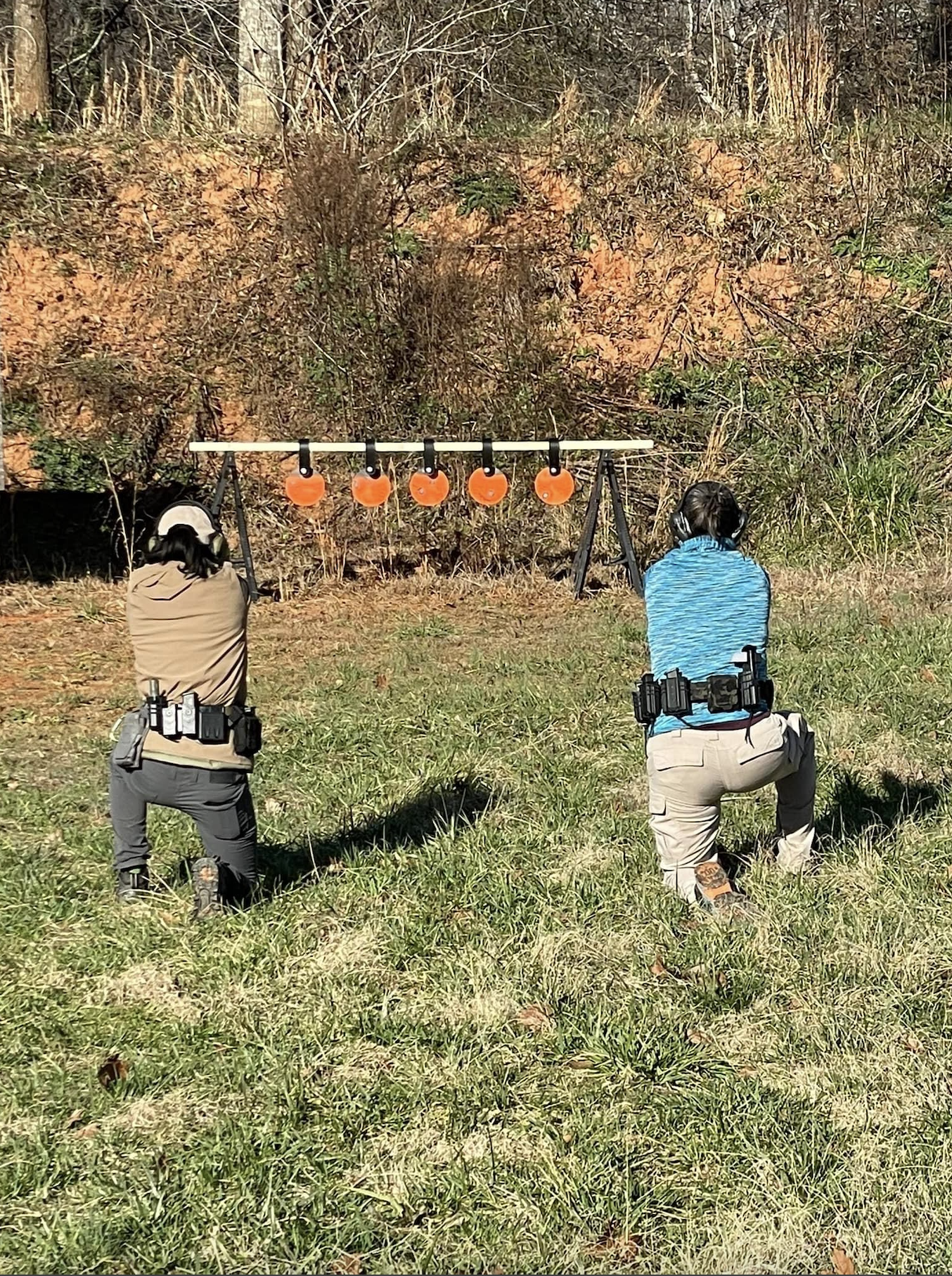
SB and I worked on pistol for an hour on steel, aiming for various targets down the line.  

We did standing and kneeling.  

We did some horizontal walking and shooting down the line.

We did singles, controlled pairs, and gradually increasing counts, from holster.


After that hour on our own, some locals led a little group class on pistol basics.  
- Mag changes
- Tap/rack/bang
- Clearing procedures
- 5 fundamentals
- Kneeling options
- Getting up and down from prone properly without flagging
- Drawing and doing Mag changes with a side step
- 180* turn and shoot
- Shoot individually for added stress


At 4pm, we did some rifle basics, from 50m, to avoid cratering.
- Loading, mag changes, and clearing
- Standing and kneeling (no prone)
- VTAC freestyle
- Off-hand shooting from VTAC
- Shooting individually for addded stress

We had dinner at the Smoking Pig - I love BBQ.

Some of us went back to the range afterwards for some bonus night fire practice. 
- Pistol at 10yd, with WML, and with a handheld light with strong and weak hand.
- Rifle individually, to understand each person's light throw at 50m (my O-light push button wouldn't work consistently, which was disappointing).  My Modlight, which I had on my other gun, sucked, and couldn't keep its wired connection, and it dimmed by itself.
- Transitions to pistol, which didn't go so well... don't know if it's because I was tired or if it was because it was at night.